The Slow Death of Ontario’s Deposit System — and Why It Matters More Than You Think
Ontario’s once highly effective deposit return system is being quietly dismantled in the name of “modernization,” fragmenting a model that reduced waste, supported reuse, and sustained local economies. What’s framed as convenience masks a broader pattern of weakening environmental and public systems—raising the question of what’s being lost, and whether a more sustainable alternative is ready to emerge.
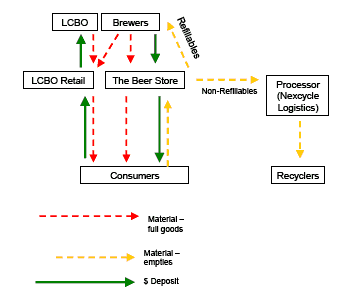
For decades, Ontario quietly had one of the most effective circular economy systems in North America. You bought a beer, you paid a deposit, you brought the empties back. Simple. Efficient. Community-based. And crucially — it worked.
Now, that system is being steadily dismantled.
Under Doug Ford’s government, the expansion of alcohol sales into big box stores and convenience outlets is being framed as “modernization” and “convenience.” But what’s being lost in that messaging is the ecological backbone that made Ontario’s beer and beverage system so effective in the first place: the Beer Store–driven deposit return system.
A System That Actually Worked
The The Beer Store achieved something rare — return rates for beer containers regularly exceeded 90%. That’s not just good; that’s world-class. Glass bottles were washed and reused up to 15 times. Aluminum cans were captured and recycled at high rates. Less waste ended up in landfills, ditches, and waterways.
And just as importantly, the system supported local jobs and informal economies. Across Simcoe North and beyond, empties were collected by individuals, community groups, and charities — turning waste into small but meaningful income streams.
Dismantling this system doesn’t just “change where you buy beer.” It fragments a highly efficient recovery network and replaces it with… what, exactly?
The “Buck-a-Beer” Illusion
Let’s not forget one of the signature promises that helped propel Ford to power: buck-a-beer. It was simple, catchy, and targeted directly at working Ontarians.
But it never materialized in any meaningful way. Even major brewers like Labatt Brewing Company and Molson Coors showed little interest in producing $1 beers at scale. A few limited promotional runs came and went, but the promise — the one that resonated with voters — quietly evaporated.
What didn’t evaporate is the long-term cost of policy decisions made in its name.
Death by a Thousand Cuts
The erosion of the deposit system isn’t happening in isolation. It’s part of a broader pattern:
Weakening environmental protections, including those affecting Ontario’s vital greenhouse and agricultural sectors
The controversial redevelopment plans involving Ontario Place and partnerships with private spa operators like Therme Group
The abrupt closure plans for the Ontario Science Centre, justified with explanations that many experts say don’t hold up under scrutiny
Each decision, on its own, might seem technical or limited in scope. But taken together, they reflect a consistent deprioritization of public, environmental, and community-focused infrastructure.
And yet — the polling numbers barely move.
So What’s Really Going On?
It’s hard to conclude that Ontarians are overwhelmingly enthusiastic about these changes. A more plausible explanation is that many voters feel stuck — disillusioned with the Ontario Liberal Party and unconvinced that alternatives are viable.
But that assumption is increasingly outdated.
A Proven Alternative
The Green Party of Ontario is no longer a fringe option or a protest vote. It’s a party with a growing track record of practical, community-focused leadership.
Just look at Mike Schreiner, whose steady, solutions-oriented approach has earned respect across party lines. Or Aislinn Clancy, whose recent victory demonstrated that voters are ready to embrace a different kind of politics — one grounded in accountability, sustainability, and common sense.
These aren’t abstract ideals. They translate into real policies:
Strengthening deposit-return systems instead of dismantling them
Investing in local economies rather than outsourcing public assets
Protecting environmental infrastructure as essential, not optional
A Different Future Is Still Possible
The decline of Ontario’s deposit system might seem like a small issue — a technical shift in how we handle empties. But it’s actually a window into something much bigger: how we value public systems, environmental responsibility, and community resilience.
We don’t have to accept their erosion as inevitable.
In Simcoe North and across Ontario, there is a growing appetite for leadership that treats environmental stewardship not as an obstacle, but as an opportunity — to build smarter systems, stronger communities, and a more resilient economy.
The path forward isn’t about going backward. It’s about choosing better.
And for the first time in a long time, that choice is clear — and it’s green.
simcoenorthgreens@gmail.com
705-345-1756