THIRTY-SIX INTO SEVEN! You need to comment on this now!!
Ontario’s proposed Bill 68 would radically centralize Conservation Authorities, replacing locally grounded, watershed-based decision-making with distant oversight spanning hundreds of kilometres. In the name of “efficiency,” this risks silencing municipal voices, discarding decades of ecological knowledge, and adding new bureaucratic layers while failing to address the real needs of flood protection, mapping, and infrastructure. This post explains why protecting local stewardship matters—and why centralization is the wrong solution at the wrong time.
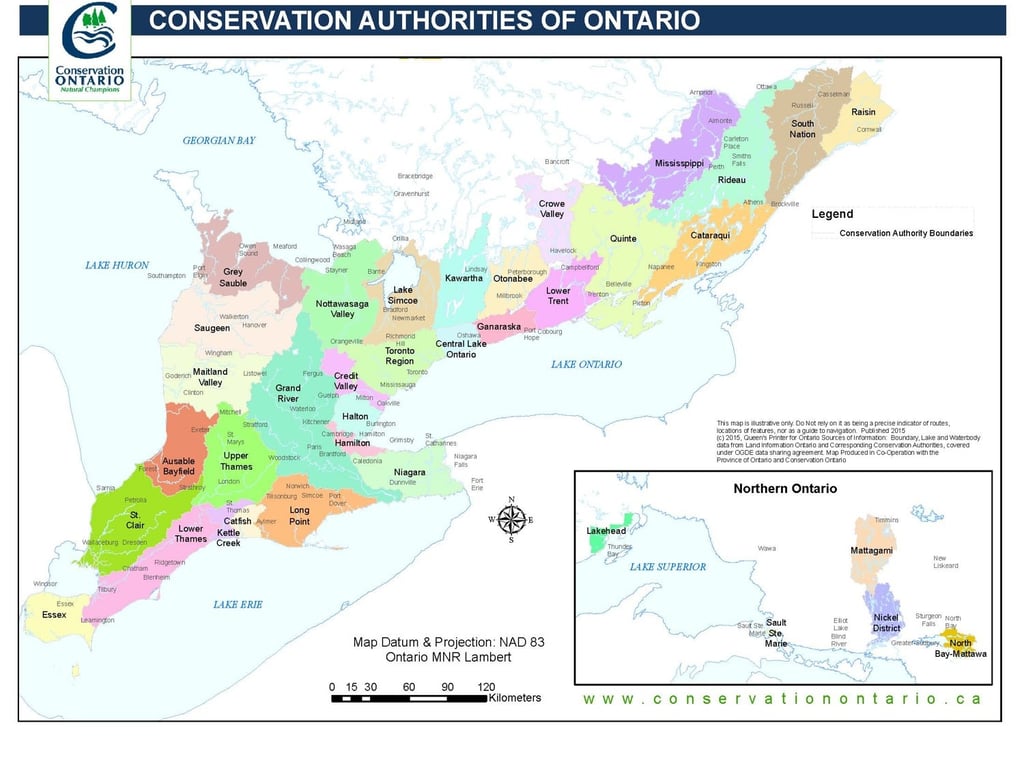
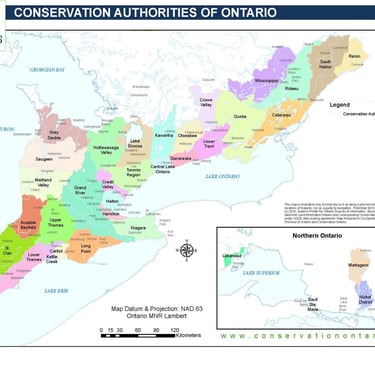
So, you paddle along the shores of Lake Simcoe and wonder: “what do I have in common with someone doing the same at the far western end of Lake Superior in sight of the Sleeping Giant?” Well, you are both in water, both in a kayak or canoe…but, is the development you see along the shore the same as what someone in Thunder Bay sees?
If the Conservative Party’s proposed Bill 68 is passed, a newly created “oversight” Conservation Authority will be making decisions for both of you. Yup, hundreds of kilometers apart, a 13-hour driveaway, yet somehow this is more efficient!
Conservation Authorities in Ontario were established on watershed boundaries. What happens in the headwaters affects what happens at the mouth. Boundaries of lower and upper tier municipalities don’t follow such ecological divisions. When a property owner in Town A decides to do something along a river it may be ok there but, properties in Town B can be severely impacted.
CA regulations ensure that the watershed’s functions are understood and provisions can be made to address, and protect local conditions along the full reach of the river, wetland, lake system that drains it. 36 into 7. That’s supposed to increase efficiencies with structures yet to be determined in how local tax levies made to CA’s are handled. For over 70 years CA’s have managed flood, erosion and source water activities on distinct watershed basis understanding local conditions, needs, priorities. There is a great deal of ‘institutional’ memory and incredible partnerships and working history between CA’s and local individuals and organizations. A lot of homes have been built in Ontario during those years, CAs are not the limiting factor now.
How does a “more centralized” voice add any efficiency when even the posting at the Environmental Registry of Ontario made a correction December 9, thirteen days before commenting closes had to be corrected? As lifted from the ERO site on December 13 (highlighting added by SNGP to draw your attention to this passage):
"This posting was updated on December 9, 2025. The updates included removing the following municipalities from the proposed Huron-Superior Regional Conservation Authority, that were included in error: the Municipality of Northern Bruce, Peninsula, the Township of Severn, the Township of Tay, and the Township of Tiny. The updates included removing the following municipalities from theproposed St. Lawrence Regional Conservation Authority, that were included in error: the Town of Prescott and the Township of East Hawkesbury"
Your local municipal voice – already constrained in other “red tape reduction” bills - will have even less input to this efficiency/centralization proposal.
What is needed from the Ontario government is not broader oversight but financial support to ensure that floodplain mapping is consistent and kept up to date across the province. Together CAs at the local level, with consistent and assured, longer-term provincial assistance, can agree to and implement more consistent timelines and fees.
Perhaps another assistance would be; put our tax dollars to work on purchasing/developing a single shared permitting portal on behalf of all Conservation Authorities. If that truly is the “red tape” piece that is delaying the “building more homes faster” then prove it. That would be a better spend than the salaries of another level of oversight (potentially politically appointed) individuals, and the costs of renaming/changing so much legal and identifying information.
Please review the full proposal and voice your concerns by December 22 at
https://ero.ontario.ca/notice/025-1257
p.s. Your input is all the more important now that the Legislature won’t be sitting until March 23, 2026 when Mike and Aislin – our two Green MPPs – can follow up and ensure our voices are all on the record.
The following links will lead you to media articles to help inform your response.
https://www.cbc.ca/news/canada/thunder-bay/lrca-council-9.7009366
simcoenorthgreens@gmail.com
705-345-1756